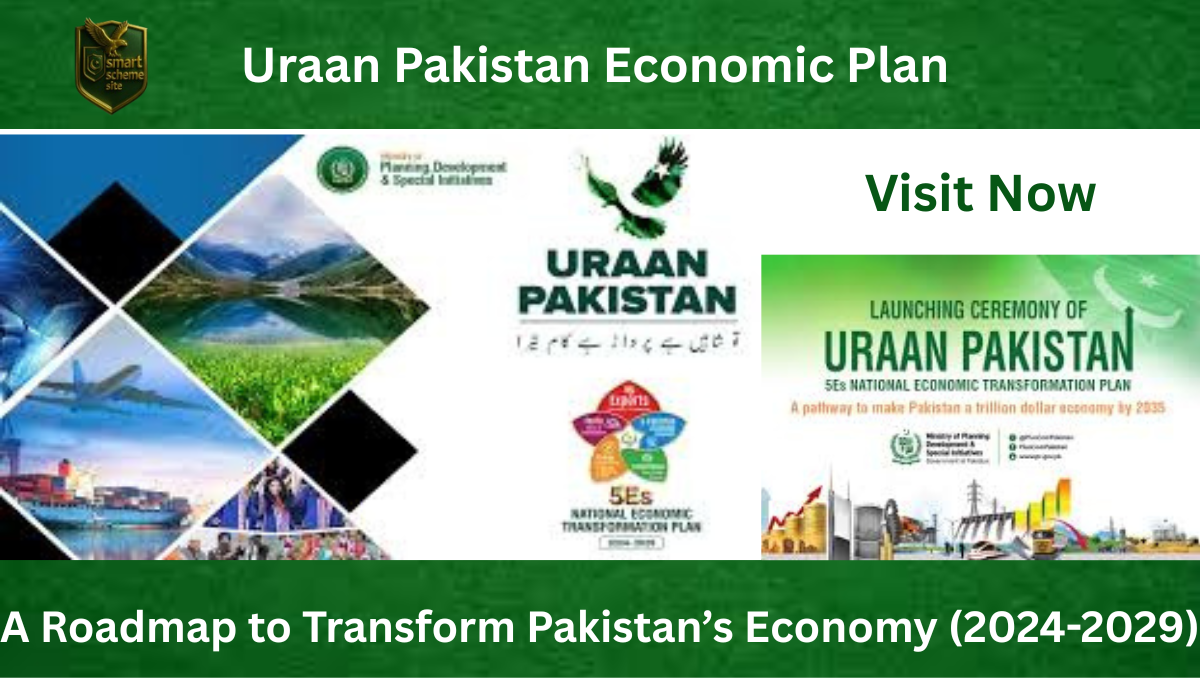
Uraan Pakistan Economic Plan 2026, Pakistan has been stuck in cycles of economic instability for decades. Recurring payment crises, a large external debt, a trade deficit and a weak growth rate have plagued the country. Keeping these issues in mind, the government of Pakistan has introduced a five-year government action plan called the Uraan Pakistan Economic Transformation Plan. Uraan means flight or ascent, and the plan symbolizes Pakistan’s determination to leave behind past failures and emerge as a strong and sustainable economy.
Also Read: https://uraanpakistan.pk/
Table of Contents
The Vision of Uraan Pakistan Economic Plan:
This plan is not just a temporary relief package but a long-term transformation agenda that aims to make Pakistan a $1 trillion economy by 2035 and a $3 trillion economy by 2047. Under the VN, the government has focused on:
- Rapidly increasing exports
- Strengthening the digital economy and IT sector
- Reforms in the energy sector and the sale of affordable, renewable energy
Also Read: Uraan Pakistan Economic Plan: A Roadmap to Transform Pakistan’s Economy (2024-2029)
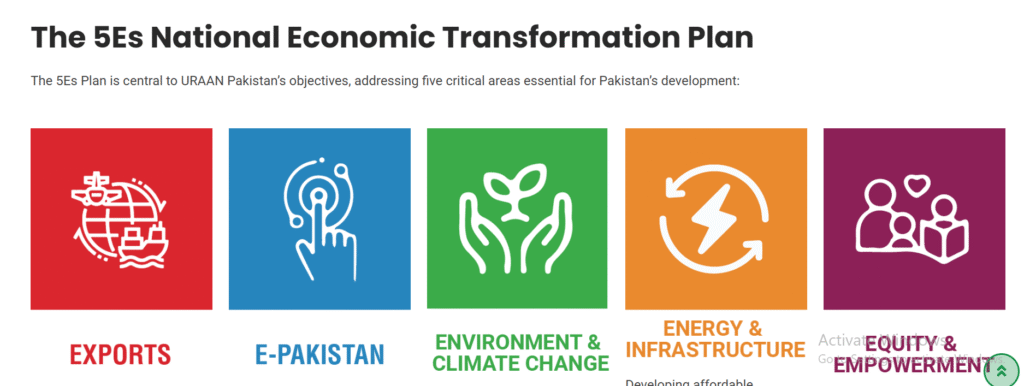
The “5 Es” Framework of Uraan Pakistan Economic Plan
Pakistan’s biggest weakness is exports. It is the task of Pakistan to increase exports to $60 billion by 2028. The following are the important steps that have been included for this:
📦Exports should be given and their markets should be developed
🏭Special economic zones should be created
🤝Small or big businesses should be facilitated
⚡Industries should be provided with cheap energy
E-Pakistan (Digital Transformation)
The digital economy actually depends on this project, due to which Pakistan’s young population has the ability to make it an IT and they should make it so. The goals included in it are listed below:
🎓Which include producing two hundred thousand IT graduations annually
💵Increase IT and freelancing exports to five billion dollars annually
🤖Promote artificial intelligence and blockchain and cyber security startups and expand them
🌐In addition, expand the internet to remote areas and provide internet access to them
Energy & Infrastructure
The pent-up energy demand is very detrimental to Pakistan’s economy. Modern energy and infrastructure improvement have been given central status in Pakistan.
Its goals are as follows:
☀️Increase solar and power projects
📉Reduce circular debt and energy losses
🛤️Expand and develop the network of roads, railways and ports
⚡Strengthen the national electricity grid
Also Read: PM Youth Laptop Scheme 2026: Eligibility, Registration & Benefits
Environment & Climate Change
pakistan is also included in the cuntries where climate changes affect , Flood and heat are the major effects :
🌍Greenhouse gas emissions will be reduced by 50% by 2030
🌾New dams will be built and water will be stored through reservoirs
🌱The area that is suitable for cultivation will be increased and food security will be improved
🌍Climate-safe agriculture will be promoted
Equity, Ethics & Empowerment
The foundation of any successful economy is justice. Pakistan’s fifth pillar is based on social justice and inclusion. It includes increasing literacy rates and youth empowerment programs. It also includes improving access to health and education. It also includes economic empowerment of women, institutional reforms, and the elimination of corruption.
Key Targets of Uraan Pakistan (2024-29)
| Focus Area | Target by 2028 |
|---|---|
| GDP Growth | 6% annually |
| Exports | $60 billion per year |
| IT Exports | $5 billion per year |
| Investment | $10 billion private investment annually |
| IT Graduates | 200,000 per year |
| Climate Goals | 50% emissions reduction |
| Water Management | Significant increase in storage capacity |
Also Read: Solarisation of Agricultural Tube-Wells in Punjab 2025 – Affordable Energy for Farmers & Sustainable
Implementation Strategy
To implement the plan, the government has established the National Economic Transformation Unit and has prepared detailed roadmaps for various sectors. The federal and provincial governments have made the sector and civil society partners and have formed a delivery unit that will monitor the rail timing.
Challenges & Criticism in Uraan Pakistan Economic Plan
The bigger the plan, the bigger the challenges it faced:
🔄Sometimes, projects fail due to lack of continuity in policies.
🐌Improper understanding and slowness can affect implementation.
💰More capital will be required to acquire large-scale infrastructure, which can be affected by trade disputes or geographical conflicts.
📑The World Bank has also highlighted that the province still lacks detailed provincial and sectoral government planning.
Conclusion of Uraan Pakistan Economic Plan
Uraan Pakistan is a revolutionary project whose success depends on political will, its continuity and collective efforts. In the past, Pakistan had many projects, but lack of implementation failed them. If this project is implemented in the true sense, Pakistan will not only be economically self-sufficient but can also emerge as a strong and stable economy on the global stage.
What is the Uraan Pakistan Economic Plan?
The Uraan Pakistan Plan is a five-year economic transformation roadmap (2024–29) that aims to boost exports, strengthen the digital economy, expand renewable energy, and promote social equity.
What are the main pillars of Uraan Pakistan?
The plan is based on the “5 Es”: Exports, E-Pakistan, Energy & Infrastructure, Environment, and Equity, Ethics & Empowerment.
What are the economic targets of Uraan Pakistan?
Targets include 6% annual GDP growth, $60 billion exports, $5 billion IT exports, and $10 billion annual private investment by 2028.
How will Uraan Pakistan benefit youth?
The plan emphasizes digital skills, producing 200,000 IT graduates annually, expanding freelancing, and creating millions of new jobs.
What challenges could affect Uraan Pakistan’s success?
Major challenges include political instability, weak institutions, financing needs, and global economic uncertainties.